
Membership software for breed clubs
Club membership software with a breed register built in
Pearce IT built a website that runs a whole breed club, not just its register: joining and renewals, the animal register, litters and puppies, breeders finding mates, rescue and rehoming, the shop and events, and the breeding law for every Australian State, on the club's own website with one login. It was built for the Murray River Retriever Association and it works for any club that keeps a register of animals.
Most clubs run their members in one system, their register in another and the rest in email and paper forms, with volunteers retyping between them. This joins them up, so the work is done once, by the person it belongs to, and checked by the officer responsible.
Why clubs need this now
The volunteers are getting older and the new ones are busy
Breed clubs, breed societies and kennel clubs run on a handful of volunteers. In many of them the people who know how everything works have been doing it for decades, and the members who could take over are working, raising children and have an evening a month to give. A club that depends on someone retyping forms into a database, chasing renewals by email and answering the same breeder's question for the fifth time does not survive that change.
This platform was designed around that. Members do their own paperwork online. The officer who is responsible approves it. The site sends the reminder, keeps the record and writes the acknowledgement, so a committee member's evening goes on decisions instead of data entry.
The result looks professional to a puppy buyer or a new member, it cuts the double handling that causes errors, and it lets a new volunteer take on one job without first learning the whole system.
Measured on the MRRA build
- 24 breeding checklists: 3 situations for each of 8 States and Territories
- 44 newsletter issues moved into a members-only archive
- 63 custom modules, about 42,000 lines, and 46 automated test suites that check them against the club's rules
- Every committee role with its own screens
What makes it different
The whole club, not just the register
Joining members to their animals is not new: registry platforms do it for breed societies overseas and for livestock studbooks here. What we did not find in any of them is the rest of what an Australian breed club actually does.
01
The whole club, not a portal beside it
Registry platforms give a club a login on the vendor's website, next to the club's own. This is the club's website: public pages, joining and renewals, the register, the shop, events, newsletters, training videos, rescue and the committee, with one login and one look.
02
Australian breeding law, built in
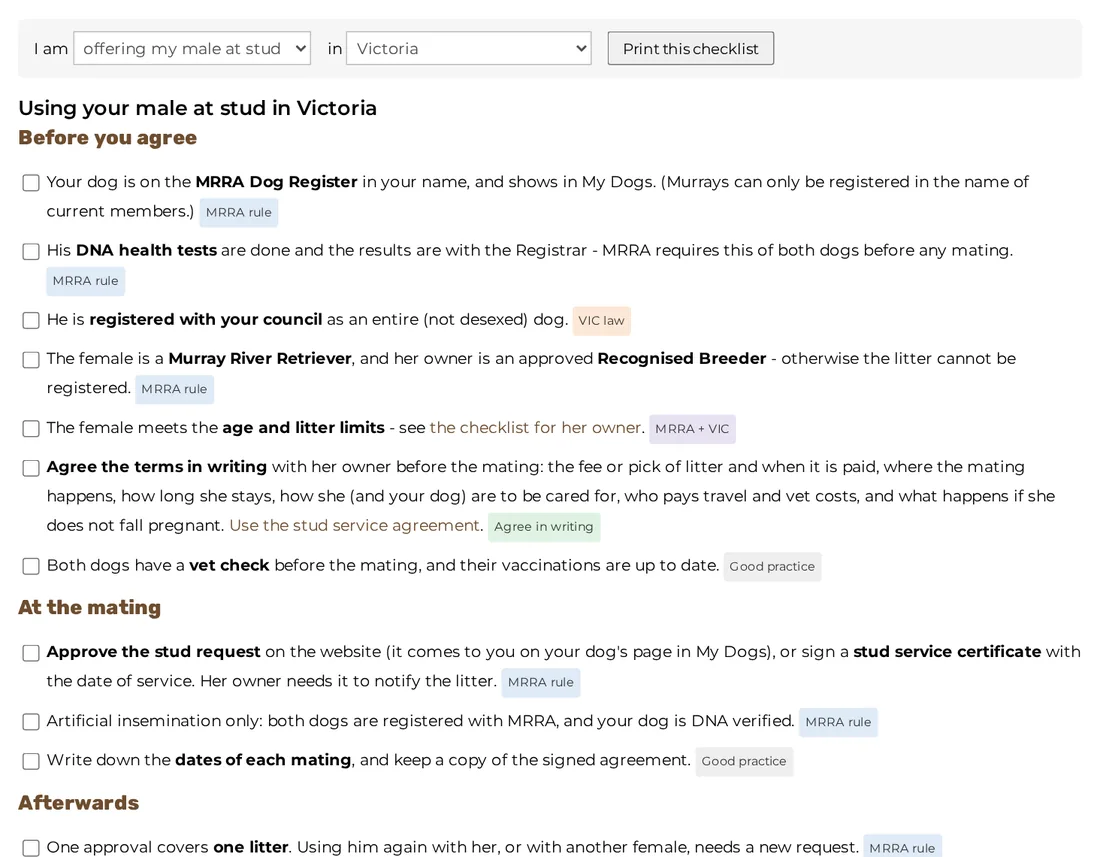
Every State and Territory has its own breeding and puppy-selling laws. The site folds all eight into the club's own rules as 24 checklists, for buying a puppy, breeding from a female and offering a male at stud, each step labelled with whose rule it is.
03
Built to the club's own rules
Incorporated associations in Australia run to their rules: who accepts a new member, when membership ends, what the register of members holds, what the Registrar may and may not decide. The website follows the club's rules clause by clause, and a change to the rules is a change to the site.
04
Protection for puppy buyers
A public check of any breeder or puppy against the register that never shows who owns a dog, and warns when an advertised dog is recorded as dead. Stud service agreements in plain English. Breeders find mates by distance, never by address.
05
Rescue and puppy enquiries in the same place
Dogs needing a new home, and people looking for a puppy matched to breeders with a litter, are handled by the same system as the members and the register, so nothing is typed twice.
06
Works with the register you already have
The Registrar keeps the club's existing register database. The website reads it and writes approved changes back, instead of making the club move its history into somebody else's system.
What it does
Membership management software, with the animals built in
Membership and renewals
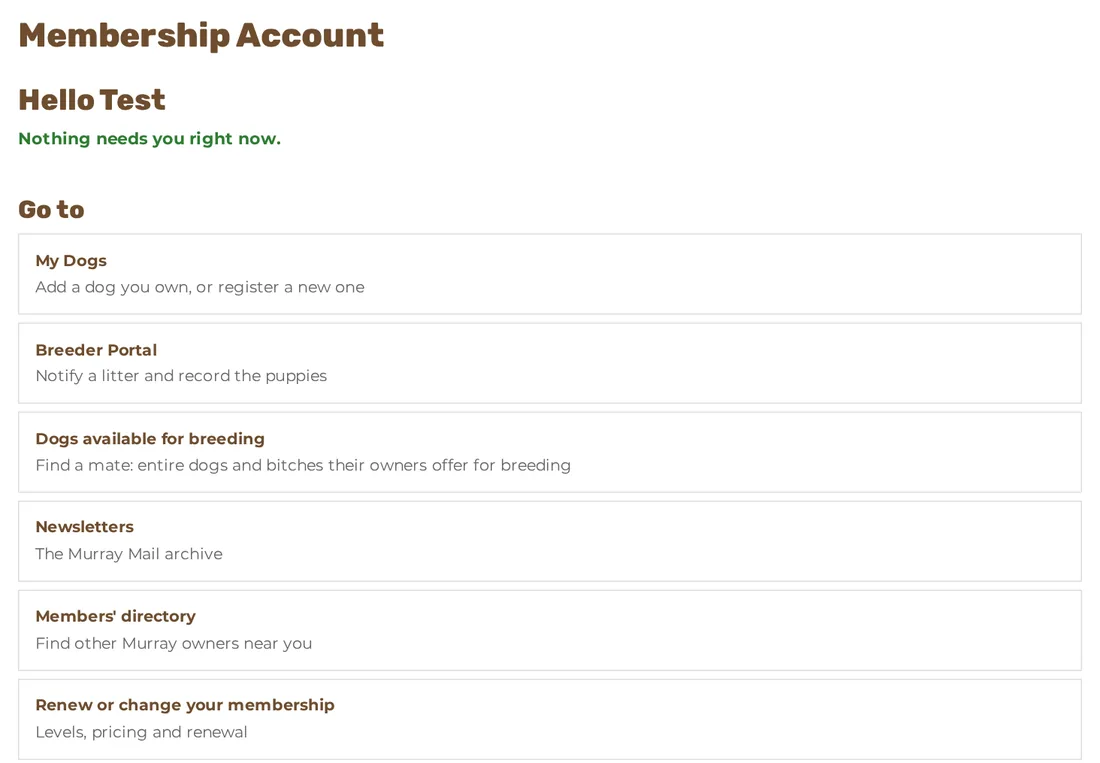
People join and renew online and pay by card. New members wait for committee acceptance, because the club's rules say so, and the committee sees a list of who is waiting. Renewal reminders go out on their own. One login covers a family. Members carry a membership card on their phone.
An animal register joined to the members
Every dog on the register is linked to the member who owns it. Members see their own dogs, register new ones and ask for changes, and nothing reaches the register until the Registrar approves it. Self-service for members, with the Registrar still holding the keys.
Litters, puppies and stud requests
Breeders notify a litter and record the puppies online. When they use someone else's stud dog, the request goes to that dog's owner to approve, so no litter is registered on a stud service nobody agreed to. Puppies move to their new owners without anyone retyping a form.
Finding a mate
Breeders search the dogs other members have offered for breeding, by distance band rather than address. Owners choose what to show. Photos are stored privately and the location data inside them is removed before anyone else sees them.
The breeding law in one checklist
Australia has eight sets of breeding and puppy-selling laws, and the club has its own rules on top. The site turns both into 24 checklists: buying a puppy, breeding from a female and offering a male at stud, for every State and Territory. Each step says whose rule it is: State law, club rule or good practice.
Check a breeder or a puppy
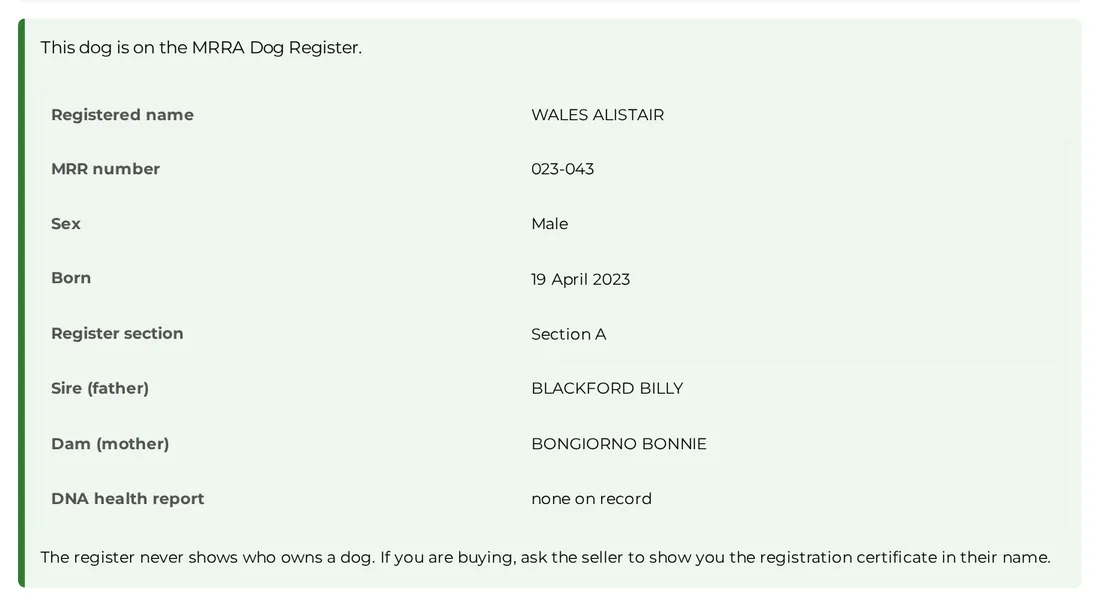
A public lookup for puppy buyers. Enter a microchip number, a registration number or a breeder's kennel prefix and get the register facts back: parents, date of birth, whether the breeder is currently recognised. It never shows who owns a dog, and it warns the buyer if the dog in the ad is recorded as dead, which is a common scam.
Stud service agreements
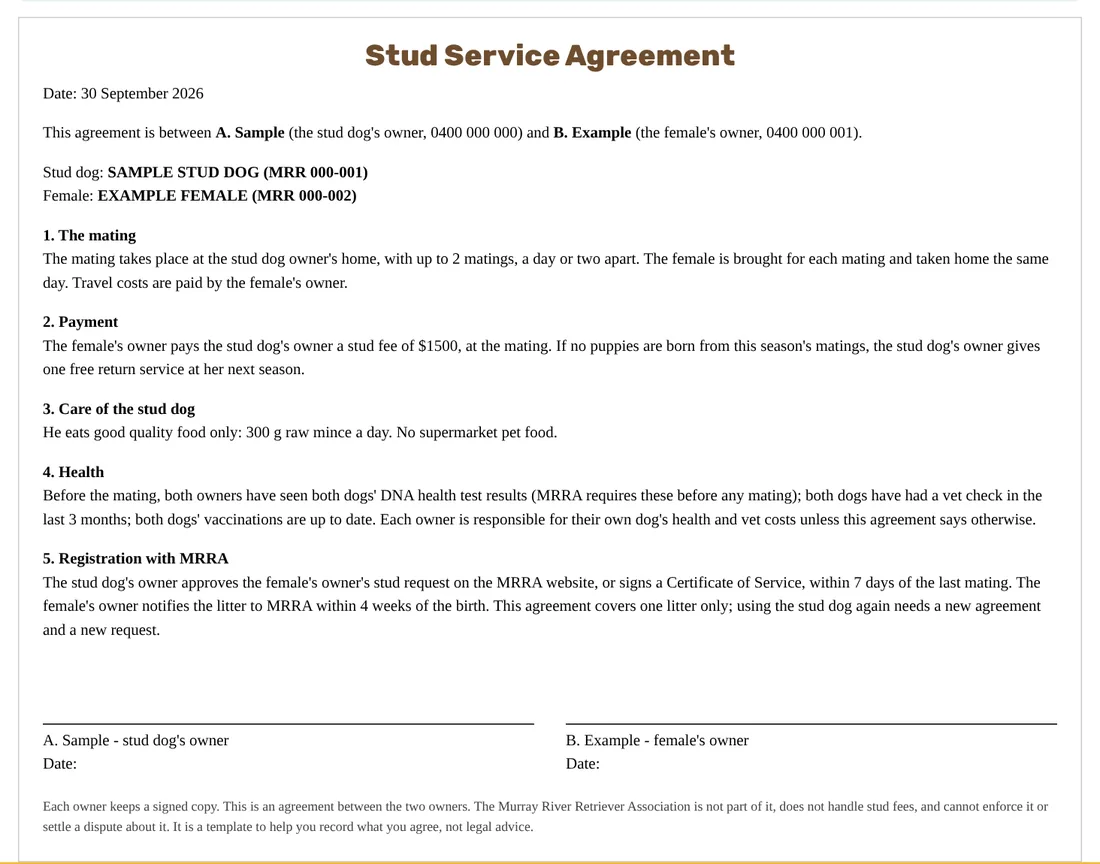
A form with drop-downs for the fee or pick of litter, where the mating happens, who pays travel, what happens if she does not fall pregnant and how each dog is to be cared for. It prints a plain-English agreement for both owners to sign. Nothing is stored.
Rescue and puppy enquiries
Dogs needing a new home are listed publicly and managed by the rescue officer. People looking for a puppy lodge one enquiry, breeders with a matching litter see it, and enquiries lapse after six months so nobody is chasing a family who bought a dog last year.
What members pay for
A members-only newsletter archive (44 issues so far), training videos, an opt-in members' directory that shows a State and a distance but never an address, and a memorial page that also works out how long the breed lives.
A screen for each committee role
The Registrar, the membership officer, the rescue officer and the rest each get an account that shows only their own area. A new volunteer can take over one job without being handed the whole website.
Contact without harvestable addresses
No email address appears on a public page. Enquiries go through one form with a drop-down for who they are for, and the site routes them. Every message gets an acknowledgement, so people know it arrived.
A shop and events
Merchandise, donations and register fees go through one cart and one payment provider. Pick-up at events and postage classes are built in, so nobody works out freight by hand.
The screens
What members and puppy buyers see
Taken on the club's test site with test accounts and sample names. Select a screen to see it full size.
Beyond dogs
Any club that keeps a register of animals
The register is built around an animal, its owner, its sire and dam, a date of birth, an identifier, health test results and its offspring. That is a dog register, and it is equally a cat stud book, a horse or pony society, a sheep flock book, a cattle herd book or a goat or alpaca registry. What changes between them is the identifier (a microchip, an ear tag, an NLIS device, a brand), the words (litter, foal, lamb, calf) and the rules the society sets. The membership, approvals, officer roles, breeder tools and public lookup carry straight across.
How it was built
The same method we use for IT
Pearce IT built the platform: the membership system, the register and its link to the Registrar's database, the breeder and officer tools, the law checklists, the public lookup, the payments, the emails and every integration between them. It took many weeks of design, building and testing, with the same discipline we apply to our clients' systems: every change tested before it goes live, and nothing reaches the live site until it has been checked.
The club's rules were the specification. When the rules say a new member waits for committee acceptance, or that membership ends on the renewal date if it is not paid, the website enforces it. 46 automated test suites check that it still does after each change, and anything that changes what members pay or see goes to the club for a decision first.
The club keeps its own data. The site runs on standard WordPress, and the register stays in the club's own database, where it can be exported at any time.
Who did what
Credits
Pearce IT
Platform, back end, integrations and hosting
Membership and renewals, the animal register, breeder and officer tools, the public lookup, payments, email and security. Pearce IT is a managed IT, cyber security and website development and SEO business in Ringwood, Melbourne.
B Creative Graphic Design
Design and front end
Rebuilt the club's public website in WordPress and Divi from its old site, keeping the look members knew. B Creative designs websites, logos and print for small businesses. bcreative.net.au
Murray River Retriever Association
The club
The breed club for the Murray River Retriever, an Australian breed. Its committee set the rules the website follows. mrr.org.au
Who it is for
- Breed clubs and kennel clubs whose register lives in a separate database or a spreadsheet
- Breed societies and stud book or herd book keepers for cats, horses, sheep, cattle, goats and alpacas
- Australian not-for-profit clubs and associations that have outgrown their membership platform
- Committees where one or two volunteers carry most of the paperwork
Straight answers
What does club membership software actually need to do?
At minimum: let people join and renew online, take the payment, remember who is financial, remind people before they lapse and give the committee a list it can trust. That part is well served by existing products. What breed clubs and breed societies need on top is a register of animals joined to the members who own them, with the Registrar approving every change. That second part is where most clubs fall back to a separate database, a spreadsheet and a lot of retyping.
Is this membership management software or association management software?
Both names describe the same job: joining and renewals, payments, committee approvals, officer roles, member communications and the records an incorporated association has to keep. This platform does all of that. What sets it apart from other membership management and association management software is the register of animals joined to the members, with litters, breeders and the breeding law built in, which general association software leaves to a separate system and a volunteer with a spreadsheet.
Is there other membership software with an animal register?
Yes. Several registry platforms join members and animals, mostly overseas subscription services and livestock studbook services. What we did not find in any of the ones we checked is the rest of the club: the club's own public website, Australian breeding law built into the club's rules, rescue and rehoming, puppy enquiries matched to breeders, and a public check that protects buyers without exposing owners. Most also expect the club to move its register onto their system; this works with the one the Registrar already keeps.
Can it work for cats, horses, sheep, cattle or goats?
It was built for dogs, but the register underneath is an animal, an owner, a sire and a dam, a birth date, an identifier, health results and offspring. That describes a cat stud book, a horse or pony society, a sheep flock book or a cattle herd book just as well. The parts that change by species are the identifier (a microchip, an ear tag, an NLIS device, a brand), the words (litter, foal, lamb, calf) and the rules. Those are configuration and wording, not a rebuild.
Can we move our members and our register across from our current system?
Yes. MRRA's members came across from its old membership system's export, and its register from the Registrar's database. The import is written so it can be run again from a fresh export on the day you switch, which means the old system stays live until the moment the new one takes over. We check the data as it comes across and report what does not fit, rather than quietly fixing it.
How is members' personal information protected?
The public never sees who owns an animal, a member's address, email or phone. Photos members upload have their location data removed. Committee officers see only the area they look after. Every email the site sends is logged, public lookups are rate limited and logged, and member data never goes into test results or reports. The club's own privacy policy sets the rules and the site is built to follow them.
Is it built on WordPress?
Yes: WordPress with Paid Memberships Pro for memberships, WooCommerce for the shop and Divi for the design. The club work sits in 63 custom modules, about 42,000 lines, rather than in a pile of third-party plugins. That choice was deliberate. WordPress is the thing a club's next volunteer is most likely to have used, and it keeps the club from being locked to one developer.
Do you build not-for-profit and club websites without a register?
Yes. The membership side stands on its own: joining, renewals, committee acceptance, reminders, officer roles, members-only content, events and a shop. It suits any not-for-profit club or association that is currently running on a membership platform it has outgrown, a spreadsheet, or one person who knows how everything works.
What does it cost?
It depends on what your club runs now, how much data has to come across and how closely your rules match what is already built. We quote after looking at your rules and your current systems rather than publishing a number, and the first conversation costs nothing.
Is your club running on goodwill and spreadsheets?
Tell us how your club works now: where the members are kept, where the register is kept and who does the retyping. We will tell you plainly what would change and what would not.